Inside the Chinese syndicates
Information obtained by this site places BC.Game inside larger Chinese syndicates, with possible connections to entities including Wanxiang and HashKey Capital.
An exposé by bcgamefiles.com. Updated 25 November 2026.
A Curacao appeal court upheld $2,162,162.10 in winnings owed to BC.Game players. The operators were declared bankrupt, the brand moved to a new company, and the players have been paid nothing. We believe it was planned that way. This exposé sets out the court record, BC.Game's own licence file, a leaked call and 23 documents.
Curacao's appeal court upheld $2,162,162.10 in player winnings against BC.Game's operators. None of it has been paid.
BC.Game's own licence file shows one Cypriot company owning both the firm that kept the debts and the firm that took the brand.
On a call recorded the day before the switch, one voice says: "I know that is not true, but who cares."
A criminal complaint in Curacao, still pending, cites habitual money laundering against people behind BC.Game's licence.
BC.Game resolved 32% of its AskGamblers complaints in 2025, the lowest of the five most-complained-about casinos.
These six findings come from information obtained by this site. None has been tested in court. Under each one are links to the published reporting we checked it against.
Information obtained by this site places BC.Game inside larger Chinese syndicates, with possible connections to entities including Wanxiang and HashKey Capital.
According to information obtained by this site, North Korea's Lazarus Group launders stolen crypto through the same kind of channels BC.Game draws on. No direct link between the two has been established.
The AAX exchange collapsed in 2022, and OCCRP has tied its founder, Su Weiyi, to suspects in Singapore's laundering case. Information obtained by this site ties BC.Game to the same circle through Singapore-based firms.
Elliptic calls Huione Guarantee the largest illicit online marketplace on record, with more than $27 billion in flows, some of it from North Korean hacks. Information obtained by this site links BC.Game to the same Southeast Asian Tether channels.
Wang was convicted in Singapore's S$3 billion money-laundering case and arrested at Tivat airport in Montenegro in early 2025. Information obtained by this site connects him to BC.Game through shared gambling networks.
According to information obtained by this site, BC.Game was founded by a man known only as Steven, and a person known as Kim later became its largest owner. BC.Game's 2024 licence filings name neither, and BC.Game has not said who owns it today.
Charges 01 to 06 are in the section above. These are the other fifteen. Here a charge means an accusation this site makes or reports. It is not a criminal charge, and each card carries a label for the evidence behind it.
Players describe the same sequence: a big win, an account frozen for "verification" or "abuse", reasons that change, and a balance BC.Game keeps.
A 400-page report filed with Curacao's Attorney General in November 2024 cites habitual money laundering, forgery and embezzlement around BC.Game's licensing. It is still pending.
Curacao's Gaming Control Board put BC.Game's licence on its public list of revocations. Weeks later the entry was gone from the register, and no reason has been given in public.
Look-alike casinos such as B9.Game copy BC.Game's name and design. Players on CasinoMeister describe deposits that vanished on sites they took for BC.Game. Who runs the copycats is not known.
BC.Game has never said who owns it. Its 2024 filings lead to a Cypriot company with one shareholder, a person with a Chinese passport.
Our sources say BC.Game's biggest players include fake accounts used to wash money. On the record: the April 2024 call discusses one player who deposited nearly $5 million and withdrew about $4.5 million without ever being identified.
BC.Game publishes lists of mirror domains and a guide that says they help players "bypass these restrictions" where the main site is blocked. Belgium fined it for illegal gambling, and the Netherlands ordered it to stop serving Dutch players.
Both operating companies were declared bankrupt in October and November 2024. The trustee found the assets had gone abroad and the estate was empty.
Through 2025 BC.Game worked to have the bankruptcy order reversed. NEXT.io reported that it would likely be lifted, and later that it was. The trustee closed the books with nothing left for creditors.
In December 2024 BC.Game gave up its Curacao licence one day before the regulator was due to rule on revoking it. The brand carried on under Twocent Technology Limited and a licence from Anjouan.
Belize's Financial Services Commission told a creditor by email that it could find no company called Twocent Technology Limited. Sweden's regulator, in its ban, lists the same name as Belize company 41939. One of the two records is wrong.
The complaint accuses Finance Minister Javier Silvania and Maltese investors, among them former Malta Gaming Authority chief Mario Galea, of fraud and embezzlement around Curacao's new licensing system. BC.Game got its provisional licence under that system. All deny wrongdoing.
On 29 April 2024, the day before the handover, two men discussed cutting every link between the two companies. One suggests having a director resign so "there would be no one to sue."
The licence file shows Mario Fiorini, of Malta's IGA Group, signing as the company's representative in November 2023 and signing the December application from an IGA email address. The application promised a segregated bank account and anti-laundering controls. The criminal complaint accuses him of helping move assets and licences out of reach. He denies wrongdoing and has not been charged.
FinTelegram calls IGA Group the Maltese power brokers behind BC.Game. The licence file shows the whole application was run through an IGA address, and Faneyte asked Curacao's central bank to revoke the licence of IGA Trust.
The criminal complaint filed in Curacao, the checks BC.Game did not run, the crypto trail around its largest depositor, its unnamed owners, and the regulators who warned about it.
On 22 November 2024, ten days after BC.Game's operators were declared bankrupt, Luigi Faneyte filed a criminal report with Curacao's Attorney General. Faneyte is a certified fraud examiner and an opposition politician. His 400-page report accuses Finance Minister Javier Silvania, former Malta Gaming Authority chief executive Mario Galea, IGA Group founder Mario Fiorini and Aideen Shortt of building a licensing system that enabled fraud, embezzlement and money laundering. He wrote that BC.Game's bankruptcy was what made him file, and that there were indications of money laundering and breaches of Curacao's law on reporting unusual transactions.
A supplement followed on 12 December 2024. It added six parties: Cedric Pietersz, managing director of the Gaming Control Board; IGA's Jeannitza Felix and Phaedra Hanst; IGA Trust B.V.; Galea's company Random Consulting Ltd; and the Gaming Control Board itself. Copies went to the FBI, New Jersey's Division of Gaming Enforcement, Malta's financial intelligence unit and gaming authority, and the Czech justice ministry. Five days later Faneyte asked the Central Bank of Curacao and Sint Maarten to revoke IGA Trust's trust-service licence.
Faneyte described Fiorini as IGA's director in practice though not on paper. The licence file shows Fiorini did put his name to BC.Game's later licence: he signed Small House's December 2023 application as its representative, using an igagroup.com email address.
Everyone named denies wrongdoing. Fiorini sued Faneyte; the court dismissed his claims in November 2026. The complaint is still pending and no prosecution has been announced.
The complaint says BC.Game got a Curacao licence with a "green seal" on 22 February 2024 and ran in crypto only, with no dedicated bank account and no KYC.
Debts of about NAf 15.5 million at bankruptcy. About NAf 4 million in player funds unaccounted for. A Spanish fine the complaint puts at NAf 10 million.
According to the complaint, the Gaming Control Board told operators by email to pay fees in crypto to Tron and Ethereum wallets. Other payments went to an account at a Czech e-money firm, under invoices that did not name the regulator.
Anti-money-laundering law requires a casino to identify its customers, check where large sums come from and report anything unusual. The evidence below suggests BC.Game did not do this with any consistency.
On the April 2024 call, BC.Game's side says it ran no KYC on a player who deposited nearly $5 million and withdrew about $4.5 million. Affiliate guides in 2026 still list BC.Game among "no-KYC" casinos where most users never verify their identity, which also means no age check.
BC.Game's anti-money-laundering page, still online, says the site is run by "Blockdance Africa Ltd" under BlockDance's Curacao number and the old sublicence. BlockDance is bankrupt and struck off. The page sets no threshold for ID checks and names no compliance officer.
BC.Game runs an in-house swap for more than 150 coins. Its 2024 footer read: "Crypto trading is not gambling by definition, therefore it is not covered by our gaming license." We could find no financial licence that covers it.
After India banned real-money gaming on 1 October 2025, Indian deposits were routed to UPI IDs belonging to private individuals. Indian tax investigators call this pattern the use of mule accounts. Pakistani players report withdrawals bouncing to a "third-party merchant" bank account.
Where regulators block the main site, BC.Game points players to mirror domains it lists itself. Its guide says they help players "bypass these restrictions."
Crypto leaves a public trail. We followed the wallet that DappRadar ranks as BC.Game's largest depositor on the Tron network, then checked every wallet around it against Tether's full list of frozen addresses and the US sanctions list.
THVYEvkvGgSN3ZYJpZ6GZK4ao4JUxEnb7RMoved $376 million in USDT between March 2024 and May 2026. Tether froze it on 14 May 2026.
$13.1mTWTaHu… TUEcZW… TN4DjE… TLUZdL… TR1CC3… TNXfui…Each received money from the hub, then passed far larger sums to one account.
$65.4mTDvWBSXHqT8gwFJej9MbXyJRJbkGVKmRk1Took in $163.7 million in one year, from only 56 wallets, then went quiet in July 2025.
$163mTAWdqn… TRGho7… TAwpAC…Wallets DappRadar tracks as receiving deposits for BC.Game.
Share of the top depositor's money that came through wallets paid by the frozen hub.
Paid out from a BC.Game deposit wallet in March 2025 to a wallet Tether froze that July.
Wallets in the money trail around BC.Game's top depositor that Tether has since frozen.
Knowing a casino's beneficial owner is the starting point of any anti-money-laundering check. BC.Game has never said who owns it. Early marketing named a chief executive called "Jack." Industry profiles name a co-founder known only as "Steven," alongside a chief operating officer, Chris Butler, and say ownership stays with the founding team. Kar Kheng Giam, appointed chief executive in March 2026, left after five months. He told NEXT.io the founder is understood to be from China, would not show his face in interviews, and that Giam had been sworn to secrecy about his identity.
Leaked Curacao licence files show that from 16 March 2024 the operating companies were owned through Fenice Tech Ltd of Cyprus, whose single beneficial owner holds a Chinese passport. The current operator, Twocent Technology Limited, says it is registered in Belize. Josimar reported that Belize's Financial Services Commission told a creditor it could find no company of that name.
According to information obtained by this site, the founder is the man known as Steven. Ownership later moved: a person known as Kim has since become BC.Game's largest owner. Neither name appears in the 2024 licence filings, which list a different owner.
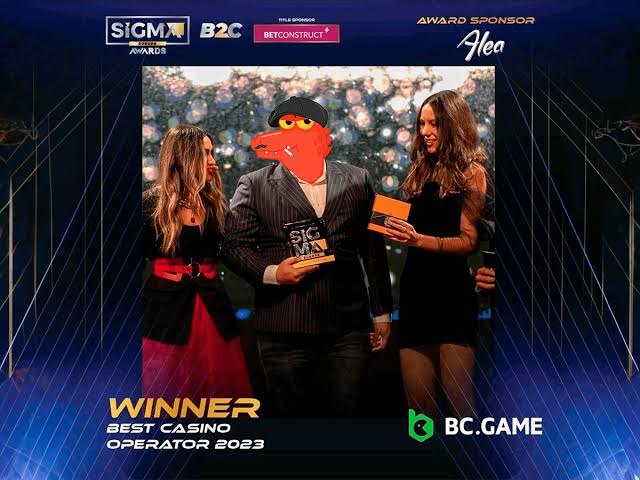
The Malta Gaming Authority says bc.game has no MGA licence and calls its claim to hold one "false and misleading."
Spanish authorities fine BlockDance EUR 5 million, according to the Curacao appeal judgment.
The Dutch gambling authority orders BC.Game to stop serving Dutch players, with a penalty of EUR 280,000 a week up to EUR 840,000.
A licence, ALSI-202410011-FI1, is issued to Twocent Technology Limited six weeks before the bankruptcy ruling.
The Gaming Control Board moves to revoke Small House's licence and gives it until 29 November to answer.
BC.Game hands back the licence one day before the regulator's ruling. The revocation entry later disappears from the public register.
Italy's regulator blocks the site for lacking a licence. Australia's media regulator and Saudi authorities act against BC.Game domains.
Spelinspektionen bans Twocent from Sweden with immediate effect after finding Swedish-language affiliates promoting the site.
We believe BC.Game moved its brand from one company to another, told the courts the debts stayed behind, and let the old company run dry. Its own regulatory filings show the same owner behind both, and a recording captures the plan being discussed the day before the switch.
In court, BC.Game's side argued that Small House B.V. had bought the brand from BlockDance B.V. in April 2024 and taken on none of its debts. BC.Game later told players to pursue BlockDance.
Small House's own licence file says otherwise. The file came from a hack of Curacao's gaming authority and was published in the Casino Secrets database in 2026. A company-structure chart dated 28 March 2024, signed for Small House's director, Wyze Management B.V., shows a Cypriot company, Fenice Tech Ltd, owning both BlockDance and Small House. One person with a Chinese passport owns Fenice.
FinTelegram and the criminal complaint both say Wyze Management is the former name of IGA Trust B.V., the Curacao arm of IGA Group. The file lists IGA Trust as Small House's official representative, and the licence contact email is an igagroup.com address.
The licence BC.Game moved onto in 2024 was not applied for as BC.Game. Small House's file describes a new, small casino aimed at Peru, Chile and Brazil. Weeks after the licence was granted, BC.Game's domains were added to it.
| Date | What the document says | What happened |
|---|---|---|
| Sep 2023 | Business plan. Small House will market "777Tigers Casino" in Peru, Chile and Brazil, on a platform rented from Anima Ltd of Malta. It has EUR 300,000 set aside to pay winnings and forecasts revenue of EUR 660,000 in 2024. BC.Game is not mentioned. | BC.Game's annual gross gaming revenue was reported at close to a billion euros. |
| 9 Nov 2023 | Corporate information form. Small House ticks "Start-up/New operation with no previous record of gaming." It leaves blank the box for an existing operation run under another Curacao licence holder. Funding: from shareholders. Representative: Wyze Management B.V. | Within five months it was running BC.Game, a brand operating since 2017. |
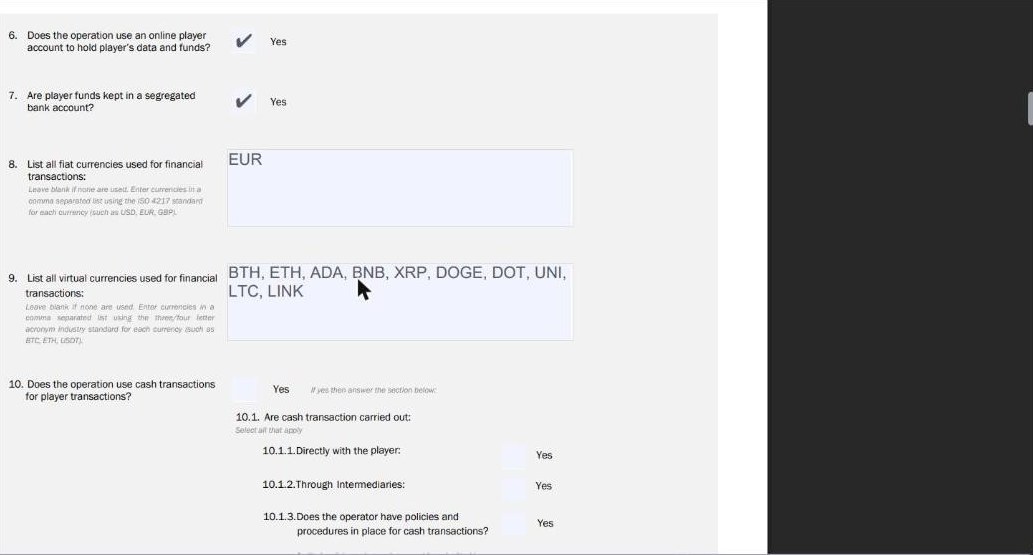
| 14 Dec 2023 | Licence application, signed by Mario Fiorini of IGA Group as Small House's representative, declaring the information "true and correct." Main website: slotngo.com. Servers: Chile, Peru, Brazil. Player funds kept in a segregated bank account: yes. Anti-money-laundering policies: yes. Self-exclusion, deposit limits and a responsible-gambling policy: yes. | The criminal complaint says BC.Game ran without a bank account and without KYC. On the April 2024 tape, BC.Game's adviser says it had no responsible-gambling tools. slotngo.com is also registered to ATOM Technology Limited in Anjouan. |
| 21 Feb 2024 | Letter from Wyze Management. "Contrary to what was previously stated in our business plan," Small House will instead use "an existing certified platform that is currently operational and licensed in Curacao." The platform is not named. The only platform contract in the file is a software licence dated 5 February 2024 from Anima Ltd. The copy filed with the regulator is unsigned, and its list of licensed operators and websites is blank. | The licence was granted the next day, 22 February 2024. No document in the file names BC.Game as the platform. |
| Mar to Apr 2024 | Domains and owners change. Until 19 February the only shareholder was the notary's incorporator, Ashmar B.V., although the November filing had already named Jeremy Fall as 100% owner. Fall held the shares for three weeks. Fenice Tech took them on 12 March. bc.game and the other BC.Game domains are added to the licence on 25 March and 9 April. A Cypriot registry certificate dated 17 April 2024 shows Fenice's 1,000 shares held by one person in China. | On 30 April BC.Game announces that Small House has taken over. |
| 13 Jun 2024 | The final licence comes with conditions. Signed by the regulator's managing director, it gives Small House two weeks to file a crypto risk policy and four weeks to prove that its compliance officer is not also its owner, CEO, CFO or COO. | Curacao registry records list the company's owner as its compliance officer: Fall until March, then the new owner from Fenice. Whether either condition was ever met is not public. |
Source: Small House B.V. licence file OGL/2023/118/0060, Casino Secrets.
The business plan describes Small House as the marketer of "777Tigers Casino", a small Latin American brand with a EUR 300,000 bankroll. The December application named slotngo.com. Within five months the same licence was carrying BC.Game, which has been running since 2017.
The "existing certified platform" Small House switched to appears in the file as a software licence from Anima Ltd of Malta. The copy filed with the regulator is unsigned and lists no operators and no websites. BC.Game's name appears nowhere in it.
In November 2023 the regulator was told Jeremy Fall owned 100% of Small House. The notary's register shows a shell company, Ashmar B.V., held every share until 19 February 2024. Fall then held them for three weeks.
Fenice Tech Ltd, which took over in March 2024, was not new. It was set up in Nicosia in 2020 with an Italian shareholder and a Larnaca nominee firm as director. By April 2024 every share belonged to one person in China.
The only source-of-funds document in the file is one person's 2022 Maltese salary statement. That was the evidence offered for a casino promising to hold players' money in a segregated account.
The final licence ordered Small House to prove within four weeks that its compliance officer was not also its owner. Registry records list the owner in that role. Whether the regulator ever checked is not public.
| Share register | Ashmar B.V. (21 Sep 2023), then Jeremy John Fall of Malta (19 Feb 2024), then Fenice Tech Ltd (12 Mar 2024). |
|---|---|
| Licence | OGL/2023/118/0060. Conditionally issued 8 November 2023, then again on 18 June 2024 under Cedric Pietersz. |
| Domains | 29, including bc.game, bc.co, bc.ai, bc.casino and bcgame.ph. Most were added on 25 March and 9 April 2024, while BlockDance was still the operator. |
| Overlap with the next operator | bc.game, hash.game, blaze.game, bc.fun and bcgame.top are also recorded for Twocent Technology Limited, which holds BC.Game's current licence in Anjouan. |
| Payments | BC.Game's own footer said Small House's payments were processed by Fenice Tech Limited. |
| Regulator's checks | In October 2024 the file still listed "critical" unresolved items on Small House's two managing directors, including an invalid reference letter and a rejected proof of address. |
The day before the handover, two men spoke by phone about BC.Game. The recording was attached to Faneyte's December complaint and later posted on YouTube. It begins with a player: a US citizen who logged in from Costa Rica, deposited nearly $5 million and withdrew about $4.5 million. There had been no KYC. The adviser says the operator would probably lose in court, because the courts "will just simply follow the rules."
They discuss the claimants' lawyer, who has written to the Central Bank and the Gaming Control Board, and a call from "Cedric" at the regulator. Then the plan: end every link between Small House and BlockDance and wind BlockDance down. One speaker notes the beneficial owner is the same but the company is different. The other suggests an agreement saying Small House bought the brand and not the player data.
I know that is not true, but who cares.
The call ends on a simpler idea: have BlockDance's director resign so the company is deactivated "and there would be no one to sue."
Details in the call match the licence file. Cedric Pietersz was the regulator's managing director. "Fedra," who handles the share transfer, matches IGA's Phaedra Hanst, whom the complaint links to the share transfers. And Fenice did own both companies.
Faneyte's complaint and the YouTube upload name Mario Galea and a BC.Game representative called "Fabiano." NEXT.io names Mario Fiorini. Both men deny wrongdoing. The recording has not been forensically authenticated; quotations come from an automatic transcript checked against the complaint.
From 30 April 2024 the bc.game footer carried a new notice: "All relationships entered into with players until 30 April 2024 remain with Blockdance B.V." The terms of service were split the same way, with one version "valid for players who signed up before 30 April 2024."
In September 2024, weeks before the first bankruptcy hearing, a BlockDance B.V. page appeared in the help centre. The players' lawyer told the regulator Small House appeared to be trying to escape claims on false grounds. He pointed out that the $1.48 million player had opened his account on 23 April 2024, when Small House already held the licence.
Reporting on the court's findings says player funds disappeared between 30 April and 10 August 2024, while control moved from one company to the other. By the time the appeal court ruled, BlockDance had stopped trading and been removed from the commercial register.
Small House gets a Curacao licence.
Fenice takes all of Small House.
The domains move to Small House.
The recorded call.
The cut-off. Old players stay with BlockDance.
Twocent gets a licence in Anjouan.
Both companies declared bankrupt.
Curacao licence handed back.
Trustee finds nothing. Bankruptcies lifted.
The player foundation SBGOK brought claims of $1,482,162.10 and $680,000, assigned to it by players from Turkey, Indonesia, Costa Rica and Austria, according to NEXT.io.
BlockDance blamed bonus and referral abuse and gaps in its own software, and counterclaimed on 21 October 2024.
The court found the defences "insufficiently substantiated." The assignment of claims was valid, there were several creditors, and the companies had stopped paying. Both were declared bankrupt in October and November 2024.
Trustee B.M. Nagelmakers reported that the assets had gone abroad and the estate was empty. On 27 October 2026 Judge D.W.J. Vinkes lifted both bankruptcies. Nothing was paid.
BC.Game's lawyers demanded that one Indonesian claimant repay $64,019.20, accusing him of running a second account. His lawyer, Roelof Bijkerk, showed on video that the second account was created automatically by a faulty Google sign-in button on BC.Game's own site. The appeal court, which heard the fraud arguments, ruled for the players.
Our legal team handled your case last year, and you lost.
We read complaints on AskGamblers, Casino.Guru, Trustpilot, Bitcointalk, Reddit and BC.Game's own forum. Players describe deposits that clear in seconds and withdrawals that stall after a big win, with an account frozen for "verification" or "abuse" and an explanation that keeps changing.
BC.Game was one of the five casinos with the most complaints on AskGamblers in 2025.
Share of those complaints it resolved, the lowest of the five. Dafabet, also in the top five, resolved 92%.
Complaints about BC.Game and related brands logged by Casino.Guru. 128 of them rejected.
Share of its negative Trustpilot reviews about withdrawals, in a 2025 analysis of more than 2,500 reviews. Trustpilot later pulled BC.Game's rating over fake reviews.
| # | Amount | What happened | Source |
|---|---|---|---|
| 01 | $1,482,162 | Won in June 2024. More than USDT 1.4 million confiscated for alleged multi-accounting. | Court ruling Curacao appeal court. Upheld, unpaid. |
| 02 | $680,000 | Second claim in the same case. | Court ruling Curacao appeal court. Upheld, unpaid. |
| 03 | $64,019 | BC.Game's lawyers demanded an Indonesian claimant repay $64,019.20, accusing him of running a second account. His lawyer showed on video that BC.Game's own faulty Google sign-in button had created it. | Court ruling The appeal court ruled for the players. |
| 04 | Rs 2.65 crore | An Indian player says access was cut and Rs 2,64,51,844 frozen under a "2099 error." | Player report Trustpilot. |
| 05 | 6 to 7 BTC | Balance frozen after winning. | Player report Bitcointalk. |
| 06 | ~$500,000 | Account frozen; the player says he lost half a million dollars. | Player report Reddit. |
| 07 | $52,000 | Account frozen for KYC straight after a win, then the winnings and funds confiscated after closure. | Player report Casino.Guru. |
| 08 | $3,655 | A level 16 player asked to have his account unblocked. It was banned permanently with the winnings inside. | Player report AskGamblers. |
| 09 | $2,300 | A test withdrawal went through. The next one, of the winnings, got the account suspended. Live chat said "wait 24 hours" for days. | Player report Casino.Guru forum. |
| 10 | £1,441.75 | A Crash player documented cash-outs that did not register. BC.Game asked him for screen recordings and would not share its server logs. | Player report |
| 11 | Not stated | A player who passed KYC was told to wait 24 hours, every day for two weeks, while a "core team" investigated an account that had placed nine bets. | Player report BC.Game's own forum. |
| 12 | Not stated | In September 2026 a player said BC.Game gave him two different reasons for locking his account and confiscating the balance. | Player report Casino.Guru. |
We do not name individual players. Player reports are the players' own accounts.
Players deposit and play with no checks. Verification starts when they try to withdraw a large win. One Nigerian player says he was asked for nine separate pieces of information, then told he had hit the submission limit with attempts still left.
Support tells players to wait a day, then says the same the next day. On BC.Game's own forum one player describes two weeks of it.
Players report one reason for a lock in an email from a "recovery team" and a different one later.
The most common grounds for confiscation. Casino.Guru flags a BC.Game rule under which low-risk play may lead to winnings being confiscated.
Players report completing wagering requirements and then having every bonus profit stripped, with no rule cited, followed by restricted access.
Indian and Pakistani players describe UPI and bank deposits that never arrive, repeated demands for statements and screen recordings, and withdrawals bouncing to a merchant account BC.Game controls.
Cash-outs that do not register, followed by requests for the player's screen recordings while BC.Game keeps its own server logs to itself.
Casino.Guru lists "limited responsible gaming options." A player says he lost his whole balance after its responsible-gambling tools failed. On the tape, BC.Game's adviser says it had no such tools at all.
Reviewers report a monthly withdrawal limit of EUR 10,000 that halves to EUR 5,000 once a balance exceeds ten times deposits. Clause 7.8 caps BC.Game's total liability to a player. Bonuses unlock at about 1% of wagering.
Let them sue us.
Giam told NEXT.io he joined to build credibility and transparency, then found that what was "happening on the ground behind my back" did not match. He described grey-market practices, operating with "cushions" to get around rules, and manipulation of Trustpilot scores he did not approve of. He left in July 2026, five months in.
Pages from Small House B.V.'s licence file, OGL/2023/118/0060. Passport numbers and private home addresses are blacked out. Tap any page to enlarge it, and use the arrow keys to move between pages.
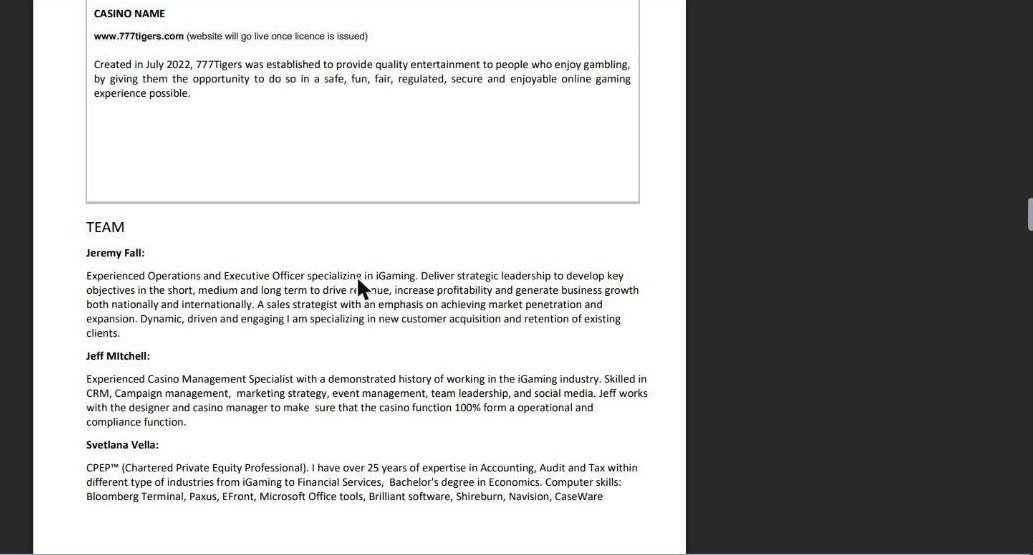 01Business plan: Small House presented as the marketer of "777Tigers Casino" for Peru, Chile and Brazil
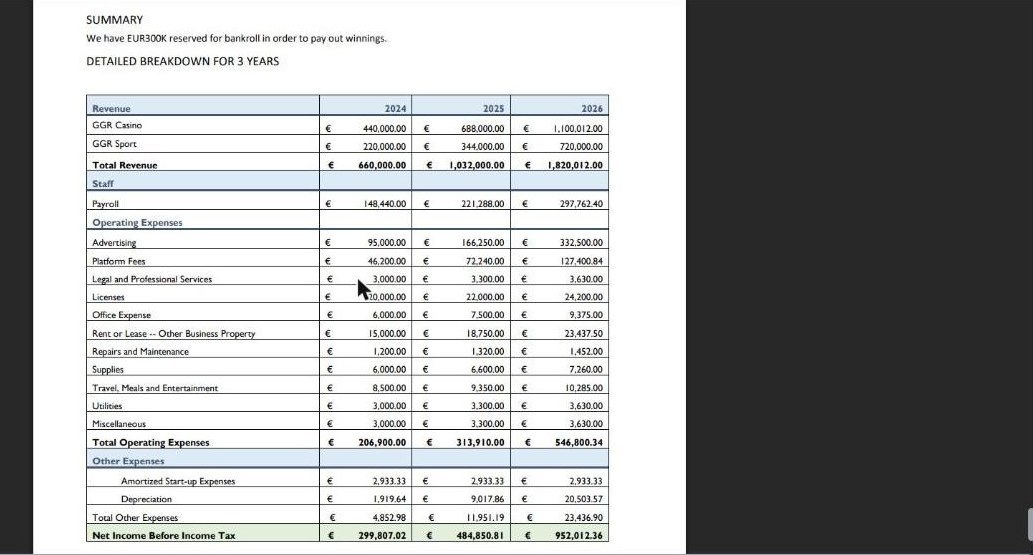 02Business plan: EUR 300k bankroll and a three-year forecast
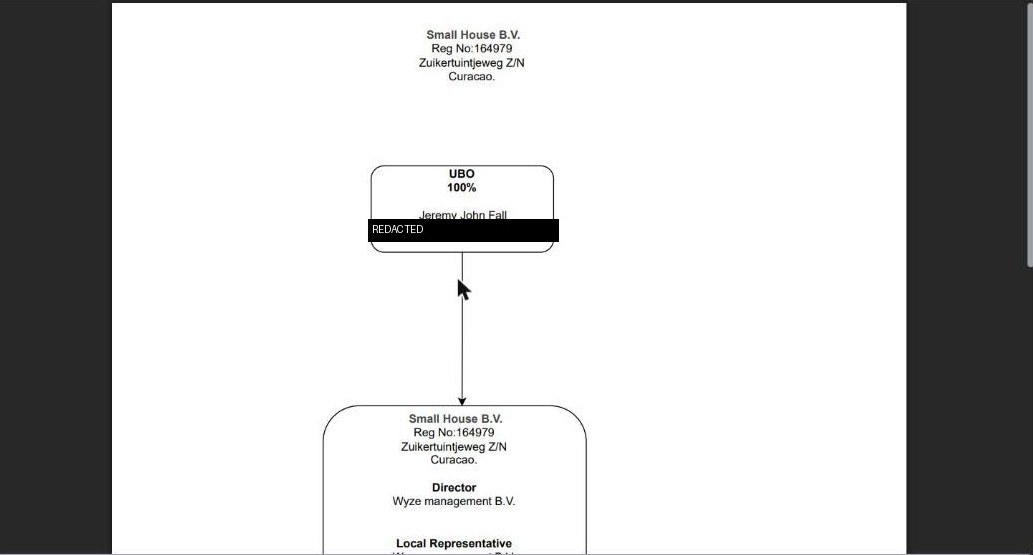 03Structure chart, Oct 2023: Jeremy Fall shown as 100% owner
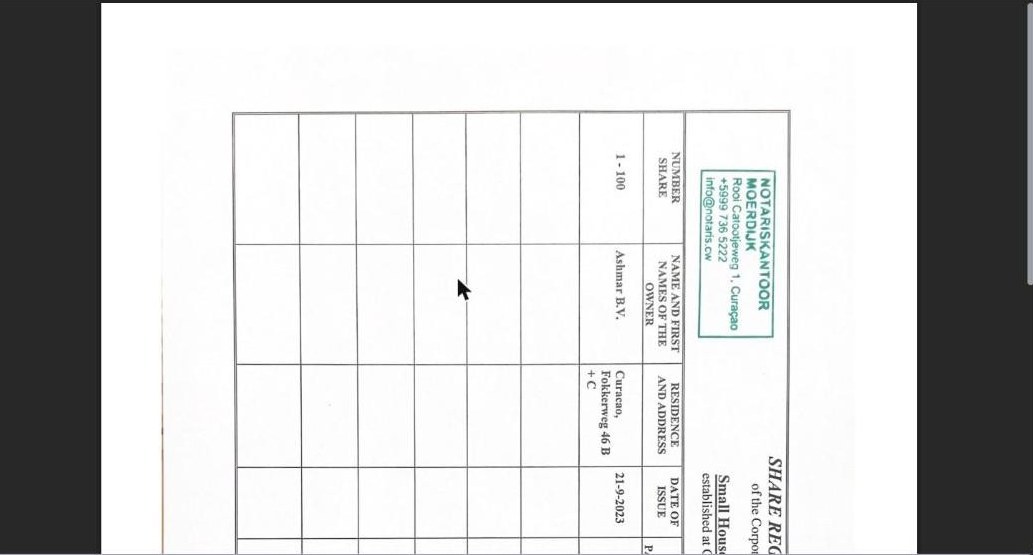 04Notary share register: the only shareholder is Ashmar B.V.
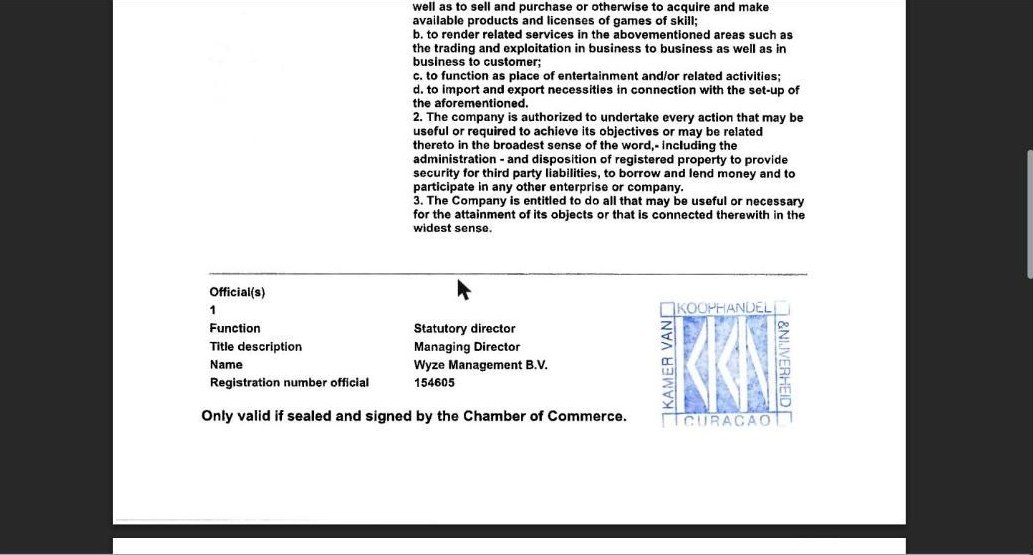 05Curacao registry: Wyze Management B.V. is the statutory director
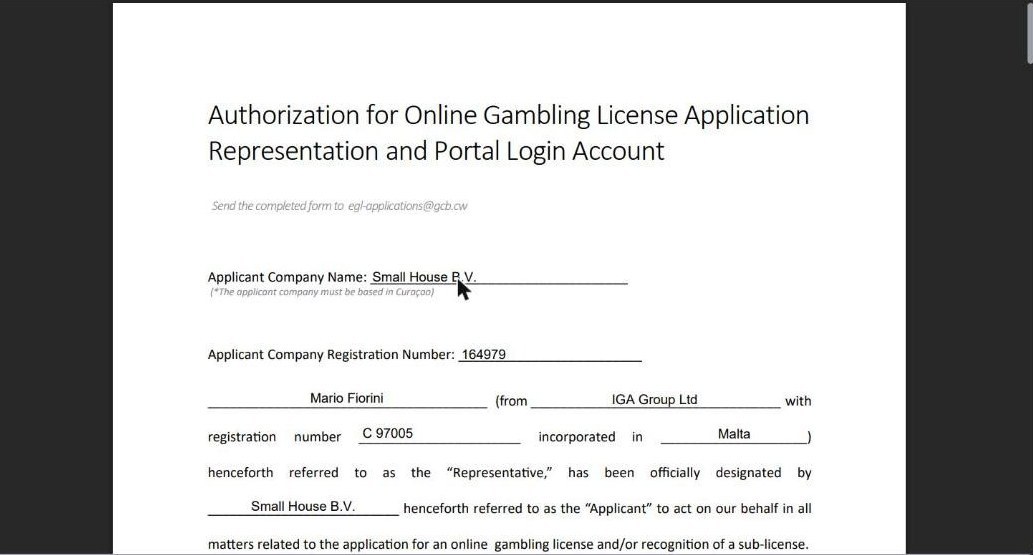 06Authorization letter: Mario Fiorini of IGA Group Ltd (Malta) named as representative
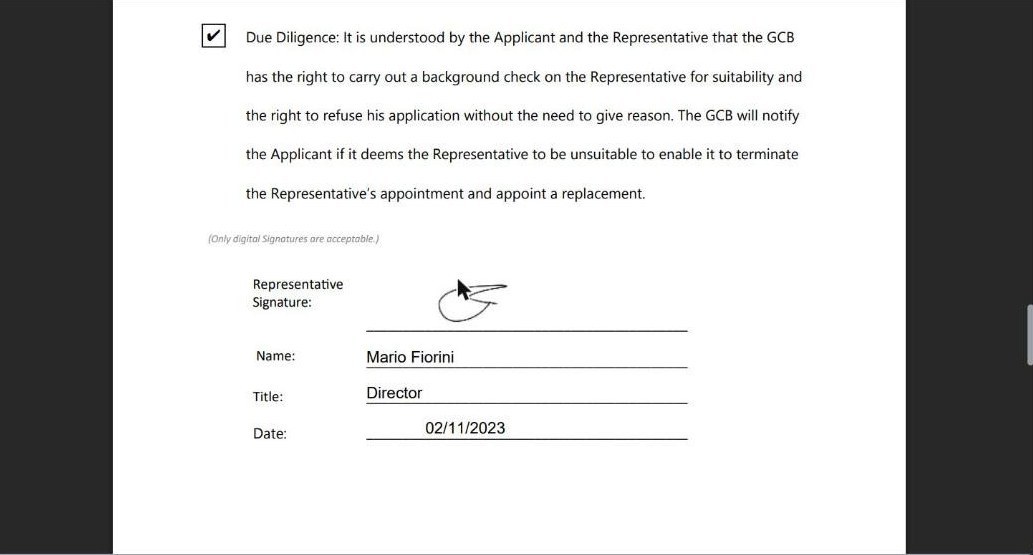 07Authorization letter signed by Fiorini, 2 Nov 2023
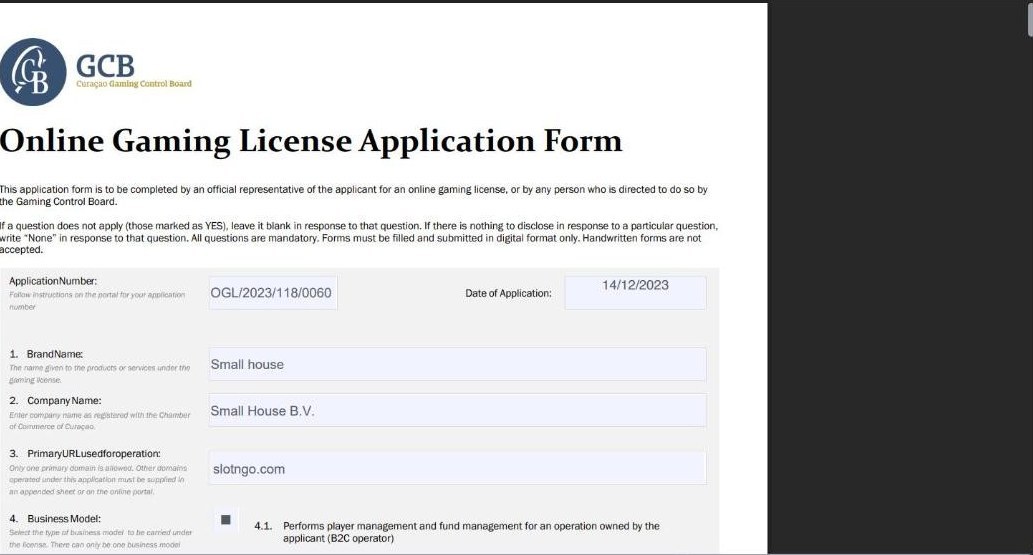 08Licence application, 14 Dec 2023: main site slotngo.com09Application: player funds in a segregated bank account, "Yes"
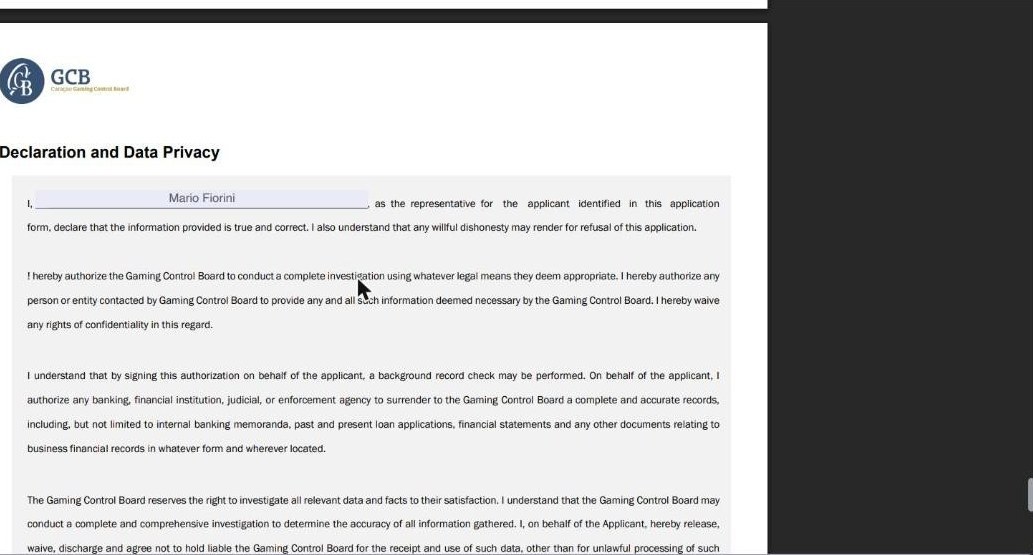 10Application: Fiorini declares the information true and correct
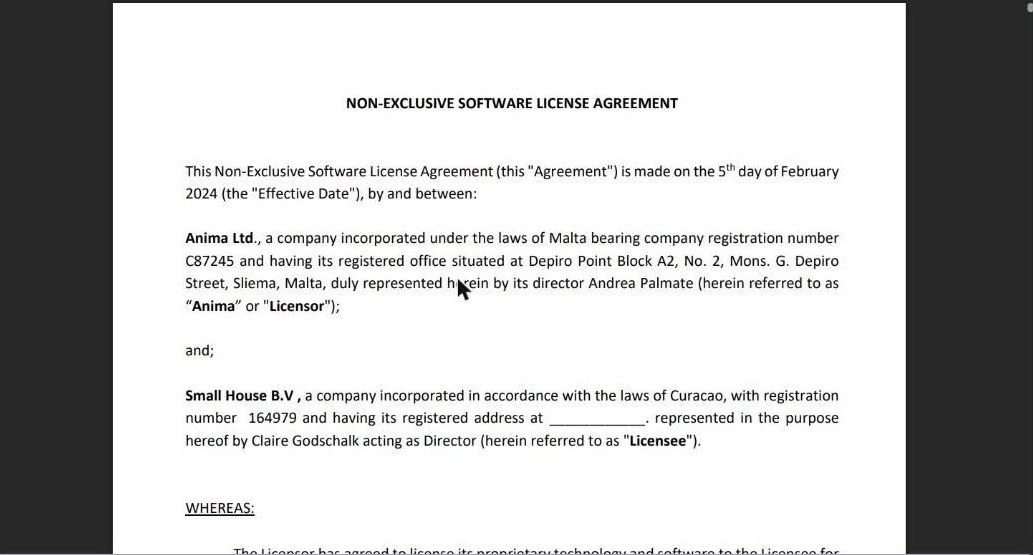 11Software licence with Anima Ltd (Malta), 5 Feb 2024
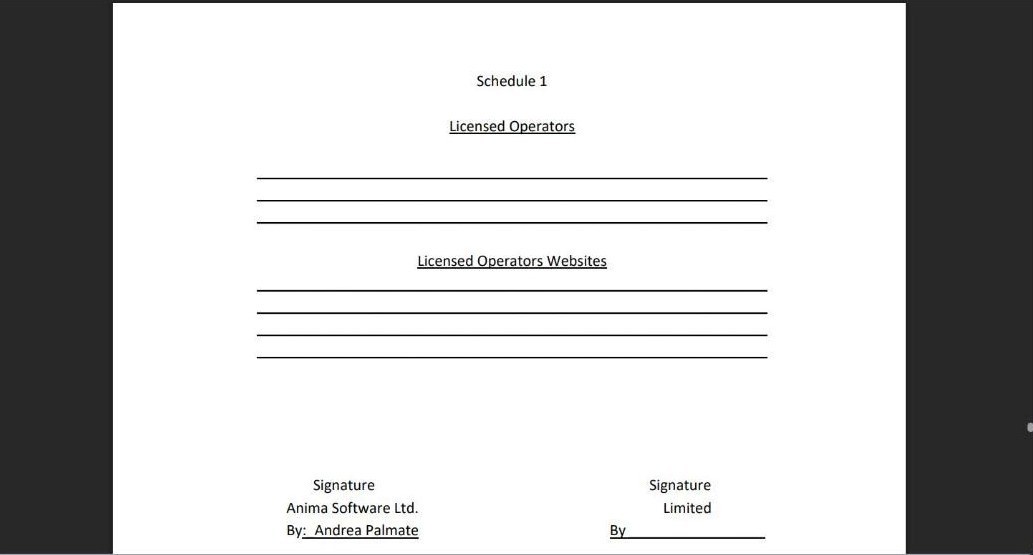 12Same contract: unsigned, operator and website list blank
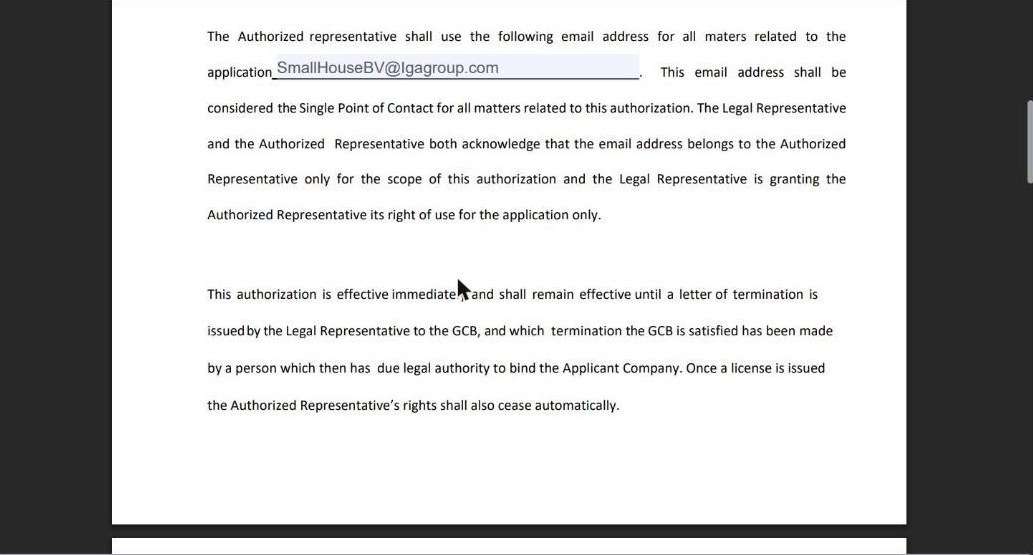 13Licensee account letter: contact email SmallHouseBV@Igagroup.com
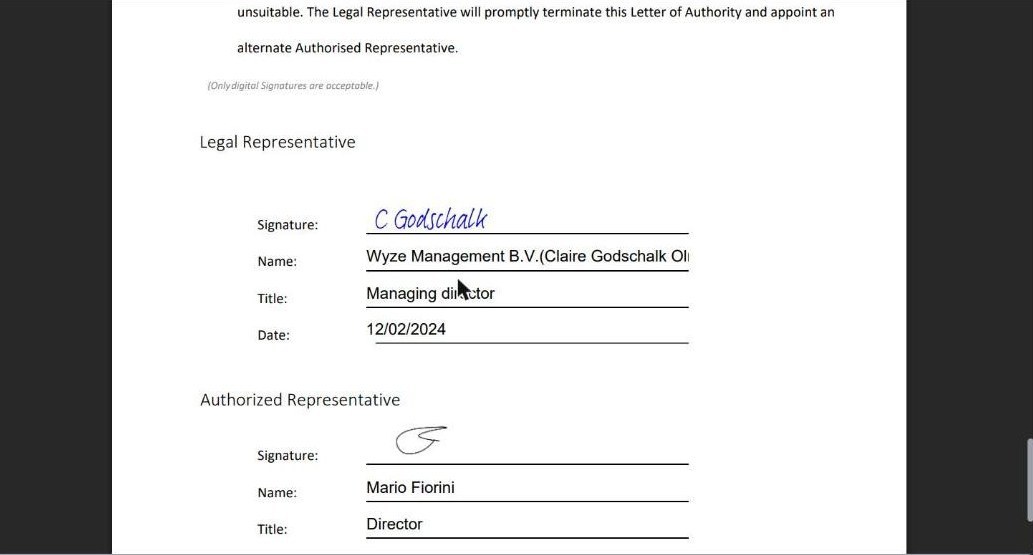 14Licensee account letter signed by Wyze and Fiorini, 12 Feb 2024
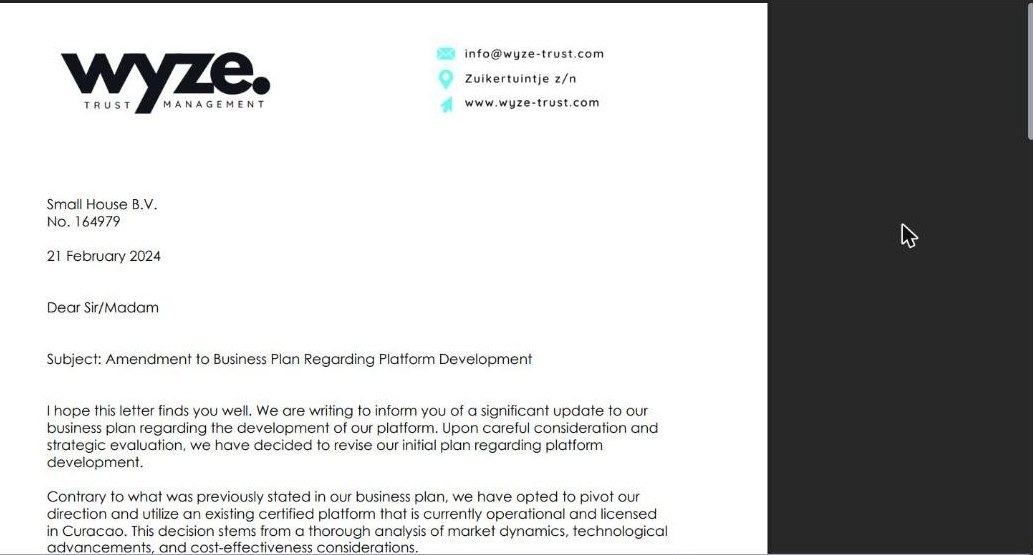 15Wyze letter, 21 Feb 2024: switch to "an existing certified platform"
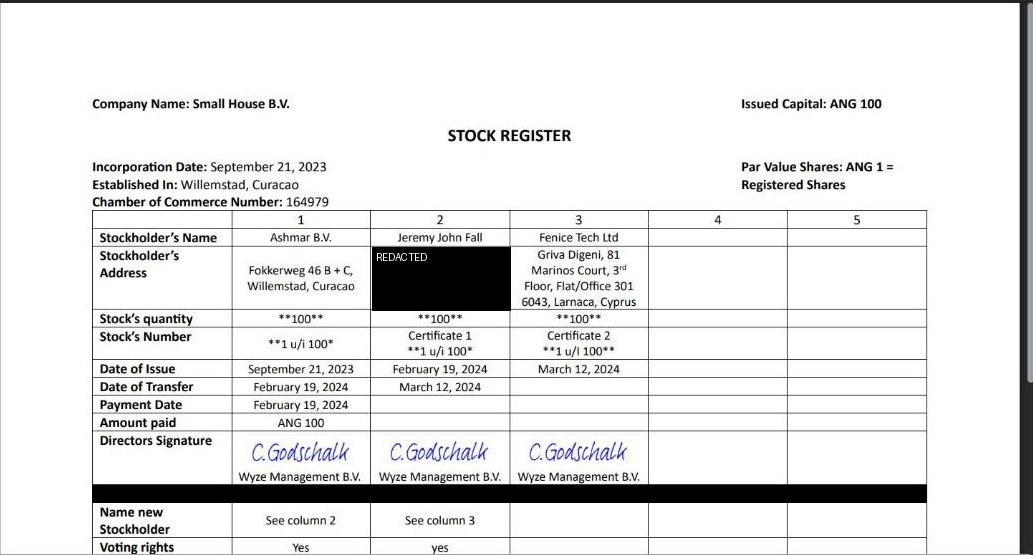 16Stock register: Ashmar to Fall (19 Feb 2024) to Fenice Tech (12 Mar 2024)
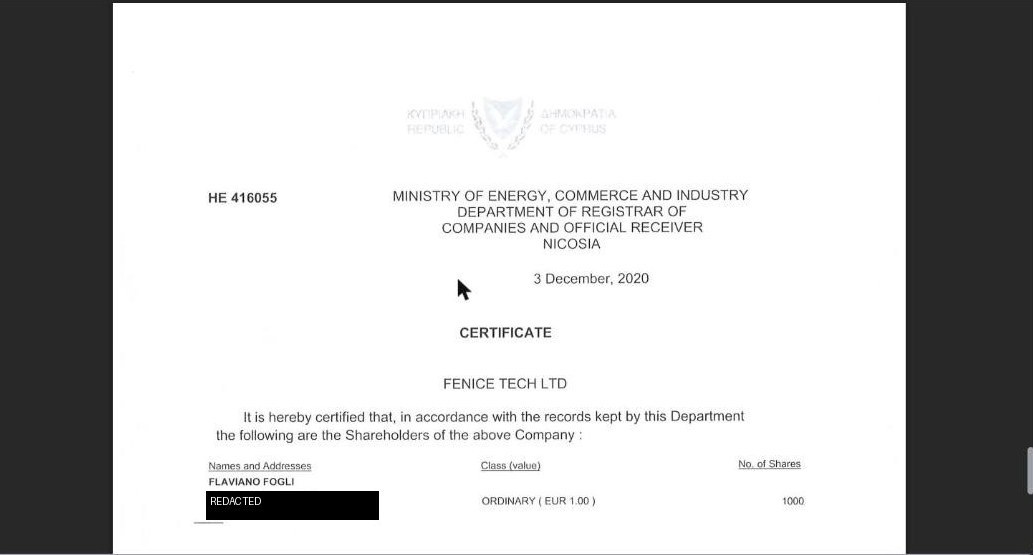 17Fenice Tech Ltd at birth, Dec 2020: one Italian shareholder
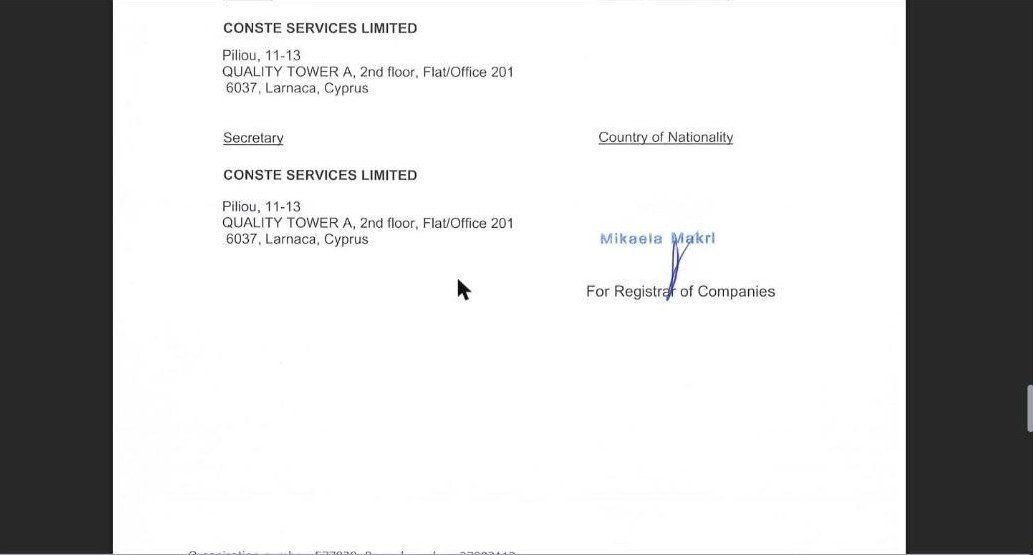 18Fenice Tech Ltd, Dec 2020: director and secretary a Larnaca services firm
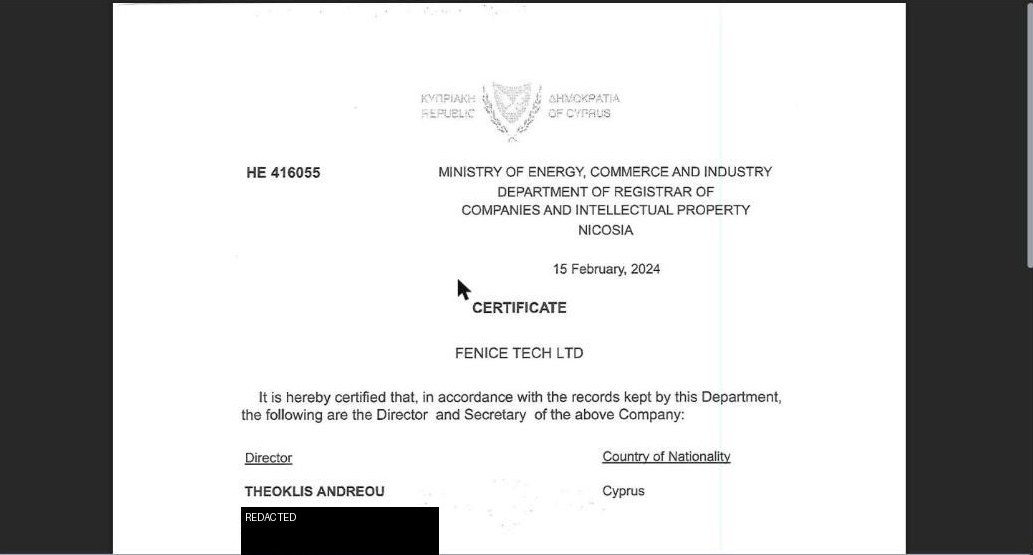 19Fenice Tech Ltd, Feb 2024: new director
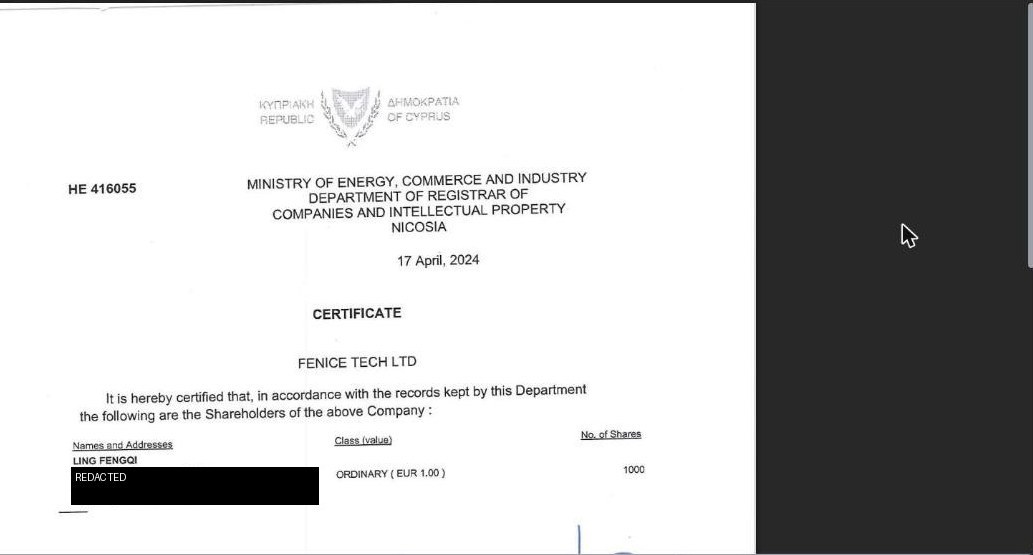 20Fenice Tech Ltd, 17 Apr 2024: all shares held by Ling Fengqi, China
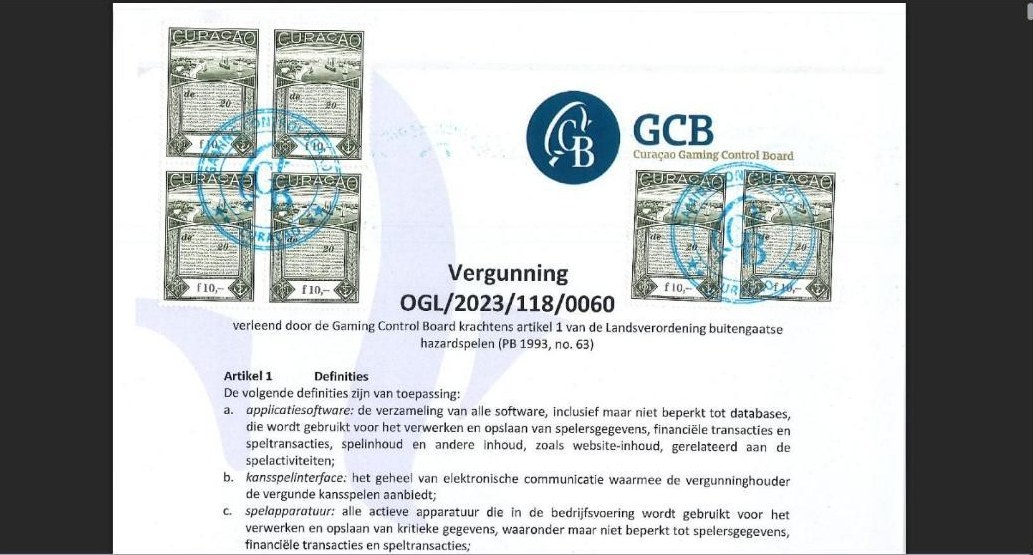 21Curacao licence OGL/2023/118/0060
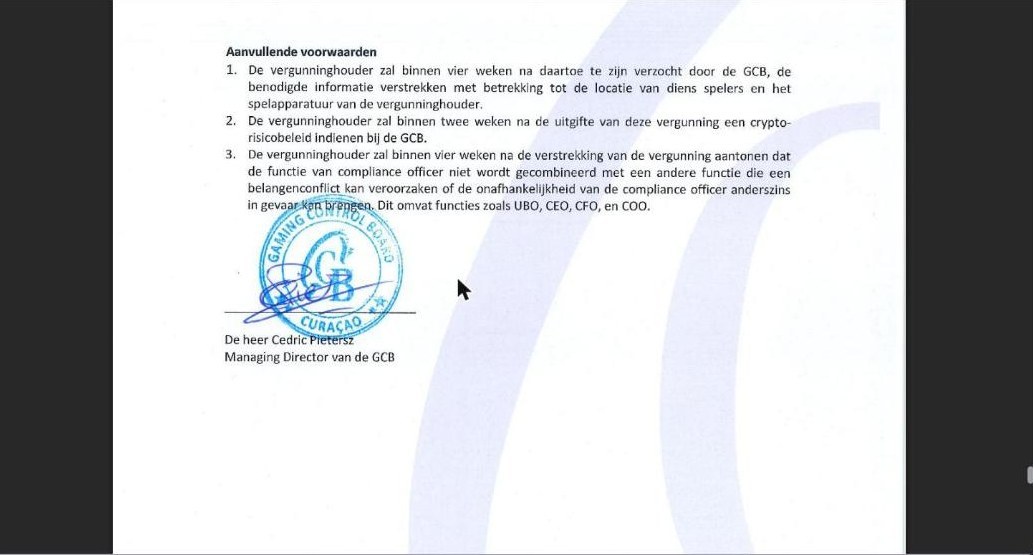 22Licence conditions: crypto risk policy, compliance officer not the owner
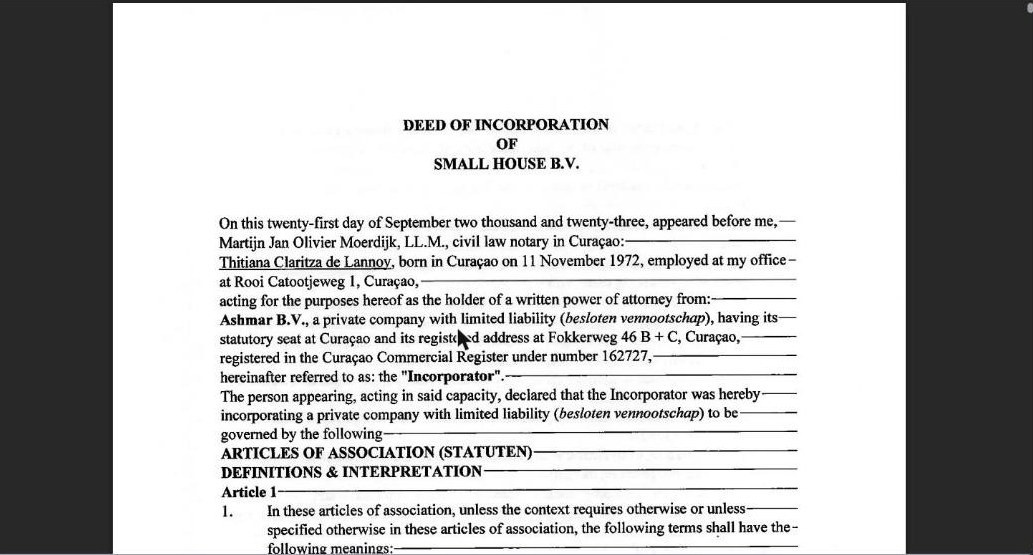 23Deed of incorporation, 21 Sep 2023
BC.Game has not answered the questions below. These are the statements it and the people named here have made in court, on its own website and to the press.
Its site footer: "All relationships entered into with players until 30 April 2024 remain with Blockdance B.V." BC.Game later told players to pursue BlockDance.
Its footer on the in-house swap: "Crypto trading is not gambling by definition, therefore it is not covered by our gaming license."
BlockDance blamed bonus and referral abuse and gaps in its own software, and counterclaimed. The court found the defences "insufficiently substantiated."
Handing back its Curacao licence, BC.Game blamed an "increasingly hostile" environment and said it would focus on global compliance. Its legal counsel told AGBrief the company wants to be compliant.
To a claimant, as he quotes it: "Our legal team handled your case last year, and you lost."
BC.Game has never said in public who owns it.
Everyone named in the criminal complaint denies wrongdoing. Mario Fiorini sued Luigi Faneyte; the court dismissed his claims in November 2026.
Curacao's appeal court upheld $2,162,162.10 in player winnings. Why has none of it been paid?
Your own filing shows Fenice Tech owned both BlockDance and Small House. Why did you tell the court the debts stayed with BlockDance?
Where did the player funds that disappeared between 30 April and 10 August 2024 go?
Who said "I know that is not true, but who cares" on the 29 April 2024 call, and what was not true?
Your licence application said player funds were kept in a segregated bank account. Which bank, and which account?
Why was your licence applied for as "777Tigers Casino," a start-up for Peru, Chile and Brazil, when within five months it was running BC.Game?
What identity checks did you run on the player who deposited nearly $5 million and withdrew $4.5 million?
Who owns BC.Game today? Who are Steven and Kim?
Belize's Financial Services Commission says it can find no Twocent Technology Limited. Where is your operator registered?
Why does your anti-money-laundering page still name Blockdance Africa Ltd, under a bankrupt company's licence number?
Why did $13.1 million from a wallet Tether later froze reach the wallets that funded your largest depositor?
Which financial licence covers your in-house crypto swap for more than 150 coins?
Why do you publish mirror domains and a guide to "bypass these restrictions" in countries that have blocked you?
Why were Indian deposits routed to UPI IDs belonging to private individuals?
Why does verification so often start only after a player wins big?
Your application promised self-exclusion and deposit limits. Your adviser said on tape you had no responsible-gambling tools. Which was true?
Each source has an archive link, in case the original is changed or taken down.
About this page. bcgamefiles.com is independent and not affiliated with BC.Game. It reports court records, regulatory filings, a leaked regulator database, published journalism and player complaints, and it publishes our analysis and opinions. Statements introduced with "we believe" or "our sources" are our opinion, based on the evidence set out here. Allegations in criminal complaints are unproven. Unless this page says otherwise, no one named here has been charged with a crime. Player reports are the players' own accounts. Everyone named has the right to respond.